
Some sounds have a way of taking you somewhere else.
For me, the ringing of temple bells still carries me back to childhood — to early mornings in India, walking to school while the sound drifted out from temples along the way. Years later, hearing those same familiar sounds in Wales can make the distance between here and home feel unexpectedly small.
Over two weekday evenings in Cardiff and Newport, that feeling returned again and again. Outside, it was an ordinary September evening: people finishing work, children with school again the next morning, everyone carrying the tiredness of a normal week. Inside, the temples were filled with bhajans, mantras, laughter, children stepping forward to take part in the pooja, and families gathering around Ganapati.
For a few hours, it felt as though a doorway had opened — from Wales into something deeply familiar.
What stayed with me most, however, was not simply the rituals or the decorations. It was watching how deliberately the celebrations made space for the next generation: children chanting, performing the pooja and being encouraged to participate rather than simply observe. And across two very different gatherings, I found the same thing happening in different ways.
An Evening in Cardiff
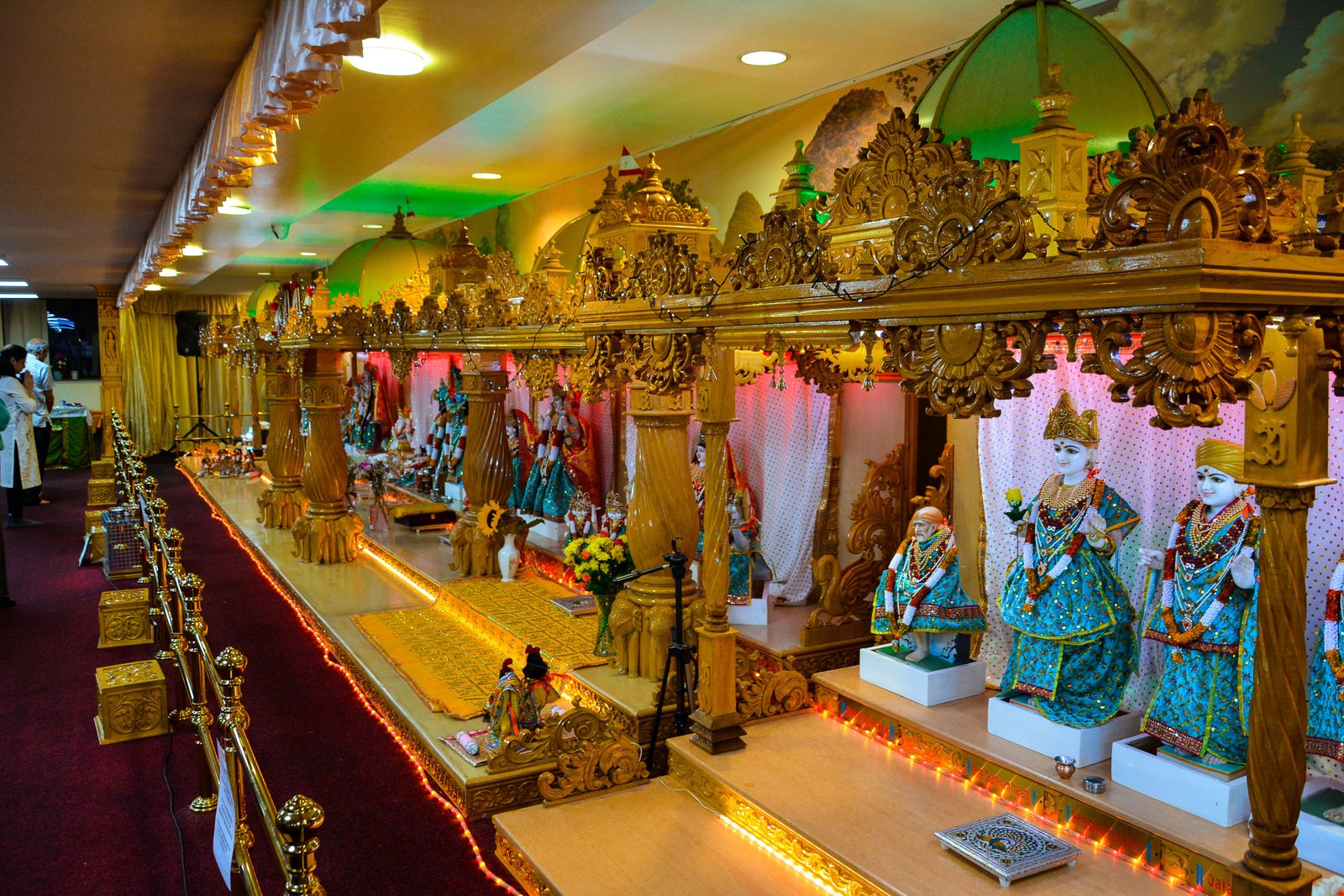
The first celebration was at Sanatan Dharma Mandal in Cardiff on Monday, 14 September. What surprised me immediately was the sheer number of people who had come out on a weekday evening. Families arrived with young children, people came after work, and yet the hall felt full of enthusiasm rather than exhaustion.
There were familiar faces too — some of whom I would see again the following evening in Newport. That, in itself, said something about the community around these celebrations: people were not simply attending an event; they were making the effort to be present.
Voices That Felt Like Home
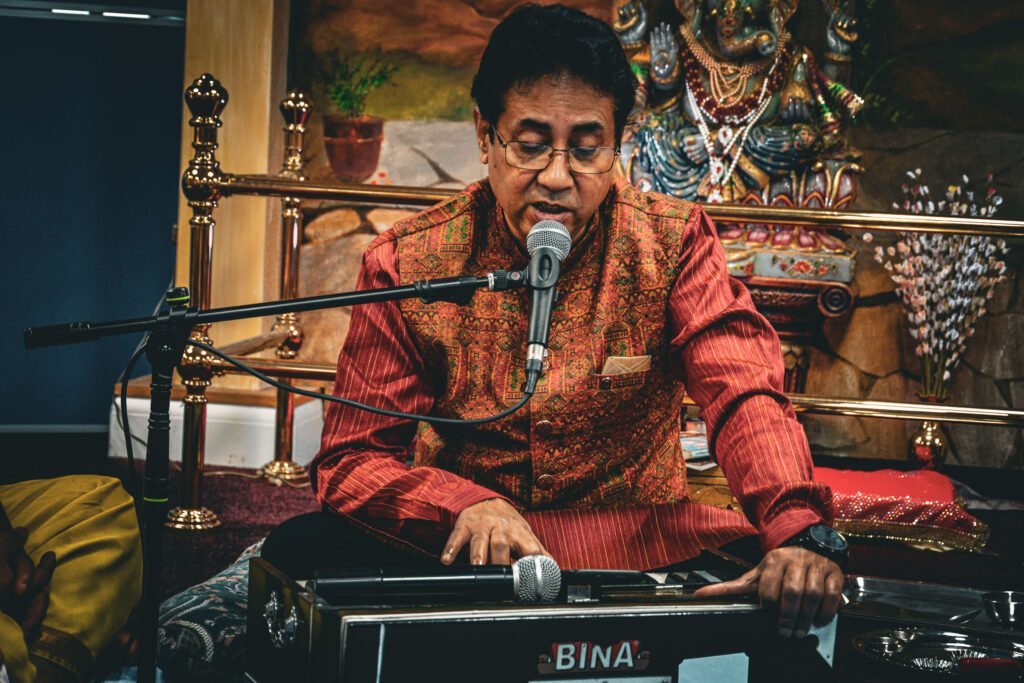
Bhajans filled much of the evening. At times it was a polished performance, and at others it was simply someone from the gathering offering a bhajan, a shloka or a mantra.
What affected me most was hearing the older members of the community sing. Listening to them brought back something difficult to describe — the familiar voices of elders at home, the kind of sound you grow up around without realising how deeply you will miss it one day.
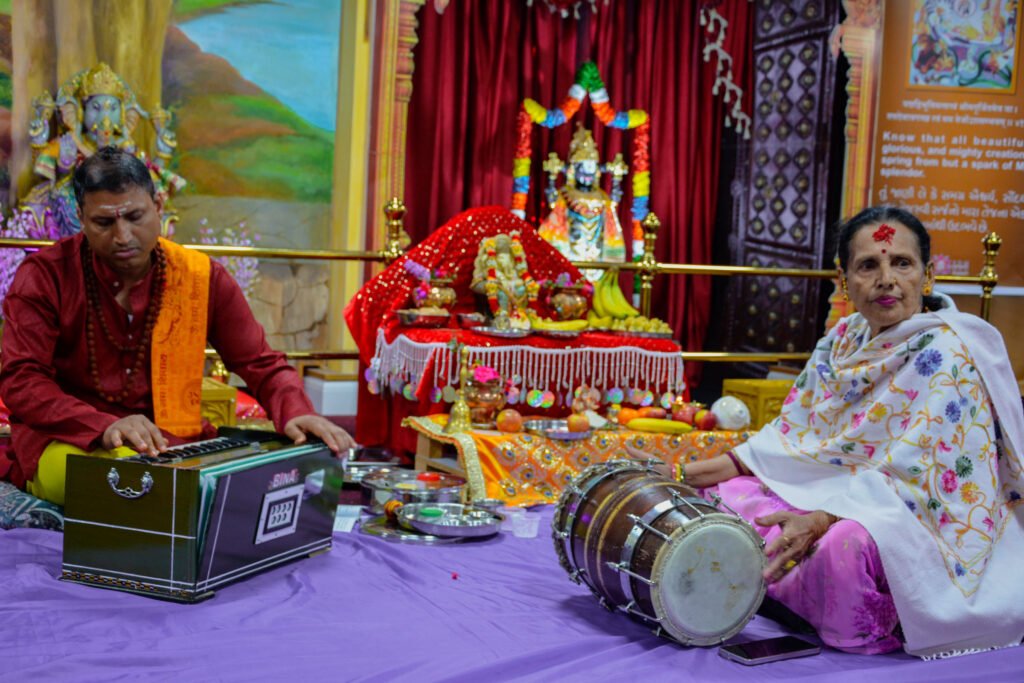
The evening also featured Saikat Mitra, an accomplished artist from Kolkata, whose performance of Itni Shakti Hamein Dena Data added another familiar note to the gathering.
Saikat Mitra: Spotify · Saregama
Giving the Children Their Place
One thing I noticed at both celebrations was how deliberately children were encouraged to come forward.
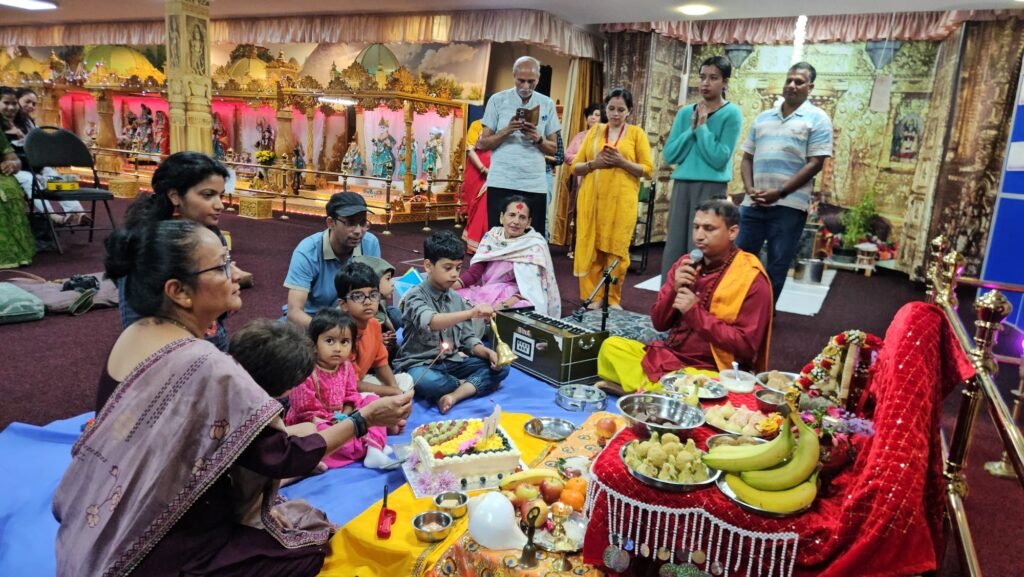
In Cardiff, the main pooja placed children at the heart of the ceremony rather than leaving them to watch from the edges.
For my family, one of the most memorable moments came when my son stepped forward and recited:
वक्रतुण्ड महाकाय सूर्यकोटि समप्रभ।
निर्विघ्नं कुरु मे देव सर्वकार्येषु सर्वदा॥
A prayer to Lord Ganesha asking for obstacles to be removed and for one’s endeavours to proceed without hindrance.
It was a small moment in a much larger celebration, but perhaps that is exactly how traditions continue — a child being given the confidence to step forward, a room full of people encouraging him, and something learned at home suddenly becoming part of a shared community experience.
The People Who Keep a Community Moving
There are always people behind these gatherings whose contribution extends far beyond a single evening.
What I have come to admire about Sanatan Dharma Mandal is the effort the community puts into bringing younger generations closer to tradition. It is not limited to festivals like Ganesh Chaturthi; children are regularly encouraged to learn through participation and activities — even something as playful as making a Ganesha idol from dough.
The intention feels simple but important: let children experience the culture with their own hands rather than only being told about it.
That same care could be felt during the prayers and chanting. The clarity of the mantras, the encouragement given to those taking part, and the willingness to involve people rather than leave them watching from the edges gave the ceremony a warmth that felt distinctly communal.
That evening, my wife was also presented with a gift by the organisers — a gesture that left her feeling genuinely blessed and once again reminded us of the warmth with which these communities welcome people.
Aarti, Prasadam and a Monday Night Crowd
The celebration eventually moved into Samuhik Aarti, with the gathering joining together before Ganapati.
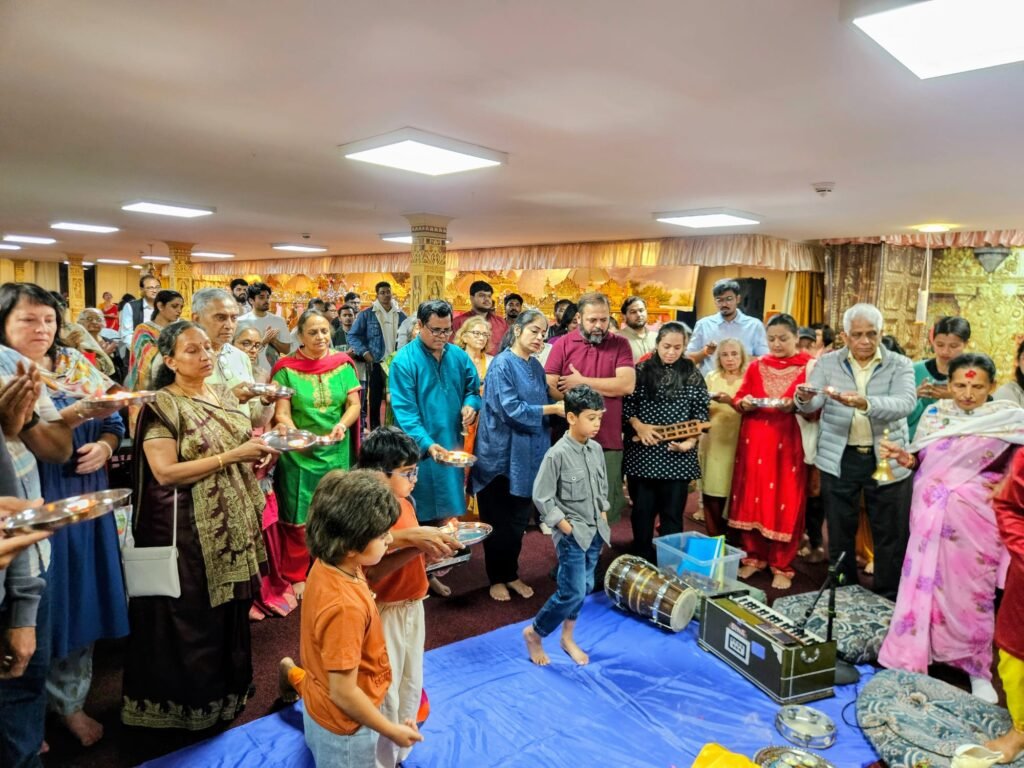
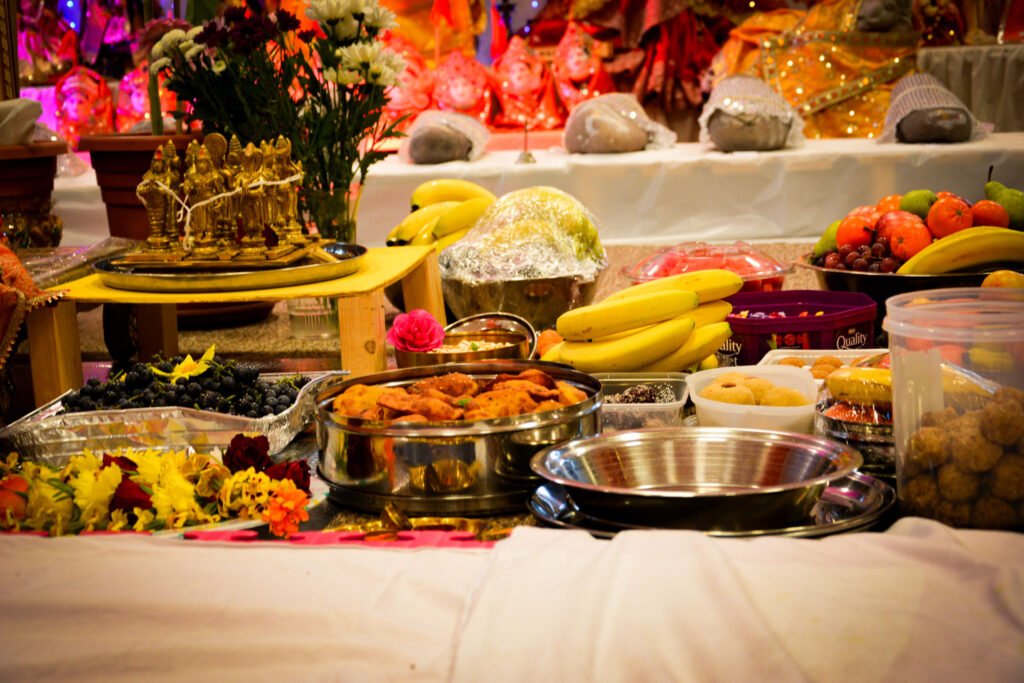
Prasadam followed on a scale that reflected the number of people who had attended.
And perhaps that is an easy detail to overlook: this was still a Monday night. Many people had come directly after work. Children would be back at school the next morning. Adults would wake up to another working day.
Yet people stayed.
They sang, prayed, helped, ate together and made time for one another.
For a few hours, the working week could wait.
Welcoming Ganapati
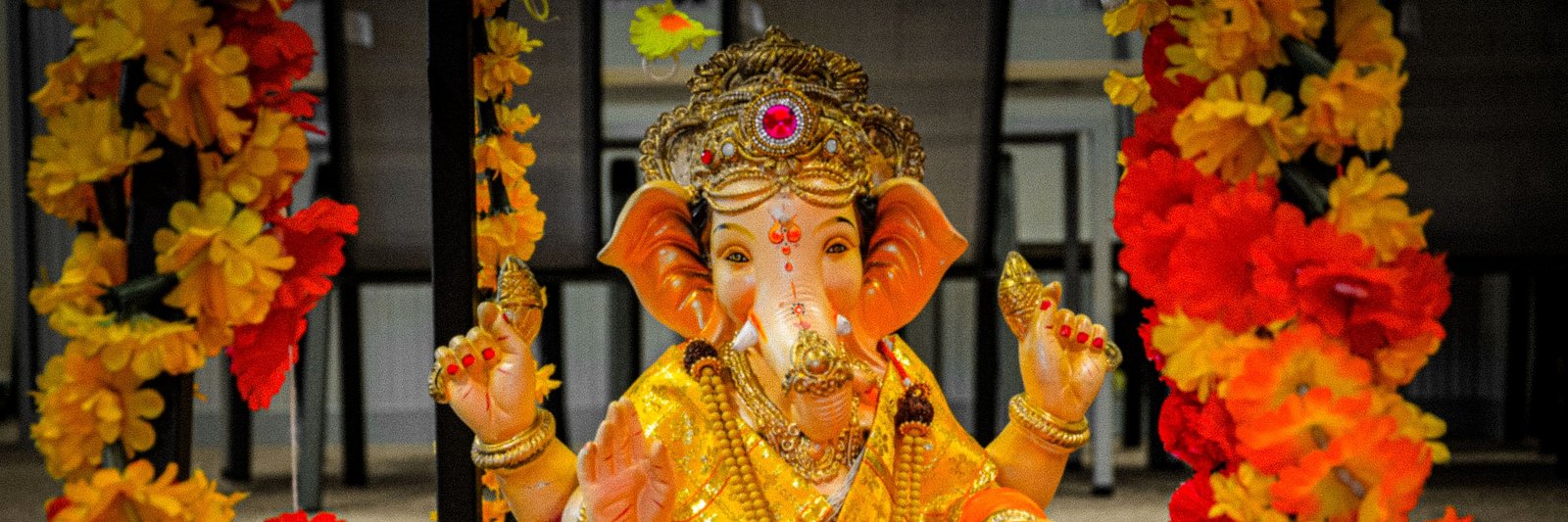
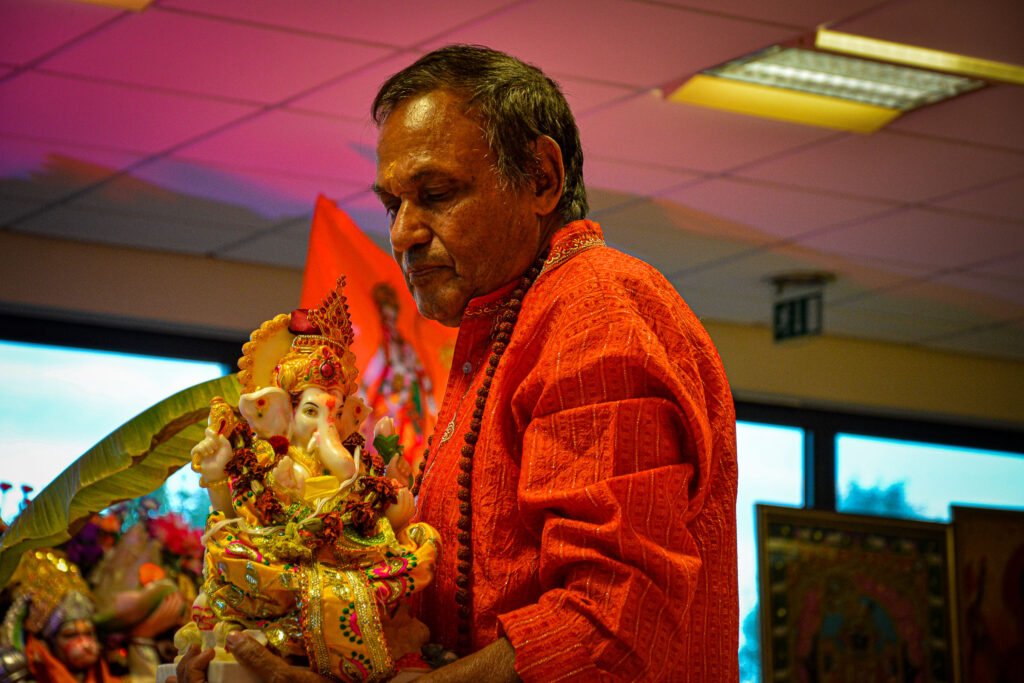
Ganesh Chaturthi celebrates Lord Ganesha — the deity associated with wisdom, new beginnings and the removal of obstacles. Across India and Indian communities around the world, the festival takes many forms: from large public celebrations to smaller gatherings within homes and temples.
At the heart of the celebration is the idea of welcoming Ganapati into the community. A murti of Ganesha becomes the focus of prayer, offerings, mantras and aarti, with families and devotees coming together not simply to observe, but to participate.
Some of the rituals I saw across these two evenings included Pran Pratishtha, the ceremonial invocation associated with welcoming the divine presence into the murti, as well as Navagraha Puja, prayers connected with the nine traditional celestial influences. What struck me, though, was how little of it felt distant or inaccessible. Children were invited forward. Adults performed parts of the pooja themselves. Instructions were given as the ceremonies unfolded.
The result was less like watching a ritual from the outside and more like being drawn into it.
And that became even more apparent the following evening in Newport.
A More Intimate Evening in Newport
The following evening, on 15 September, we arrived at Dharma Mandir in Newport.
The gathering was smaller than Cardiff — perhaps unsurprising for another weekday evening — but that changed the character of the celebration rather than diminishing it. With fewer people in the room, everything felt a little closer. There was more conversation, more opportunity to participate, and less distance between those organising the ceremony and those who had come to attend.
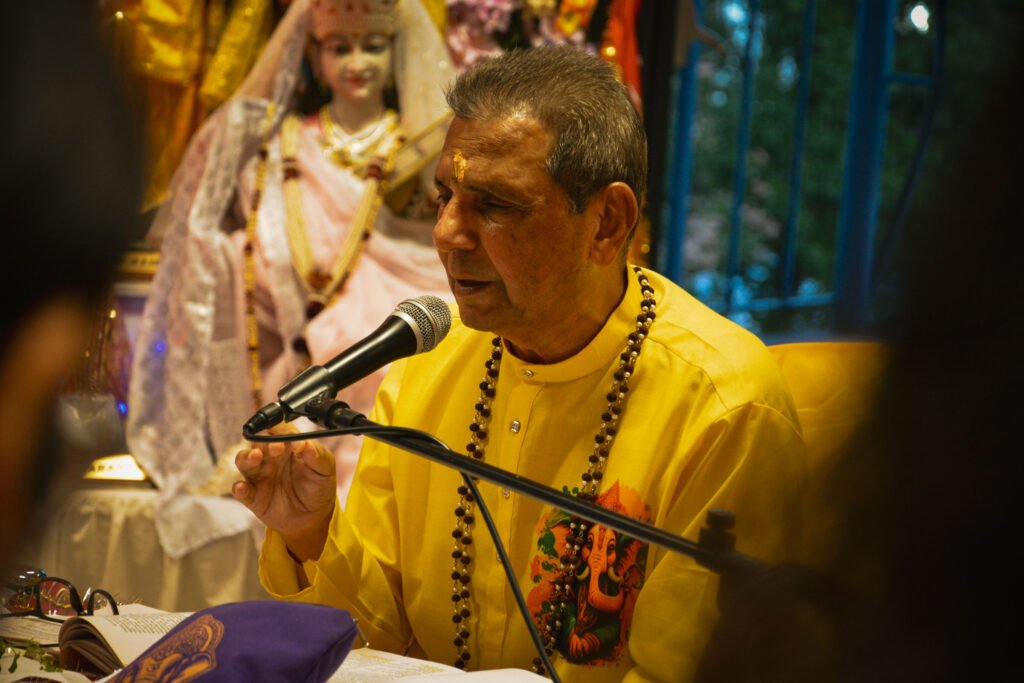
The evening began with Vedic mantras under the guidance of Guru Vyas Sharma.
I have always found there is something remarkable about the way Guruji tells a story. His words do not feel like an explanation of something distant; somehow, as he speaks, the story begins to feel as though it is unfolding in the room around you.
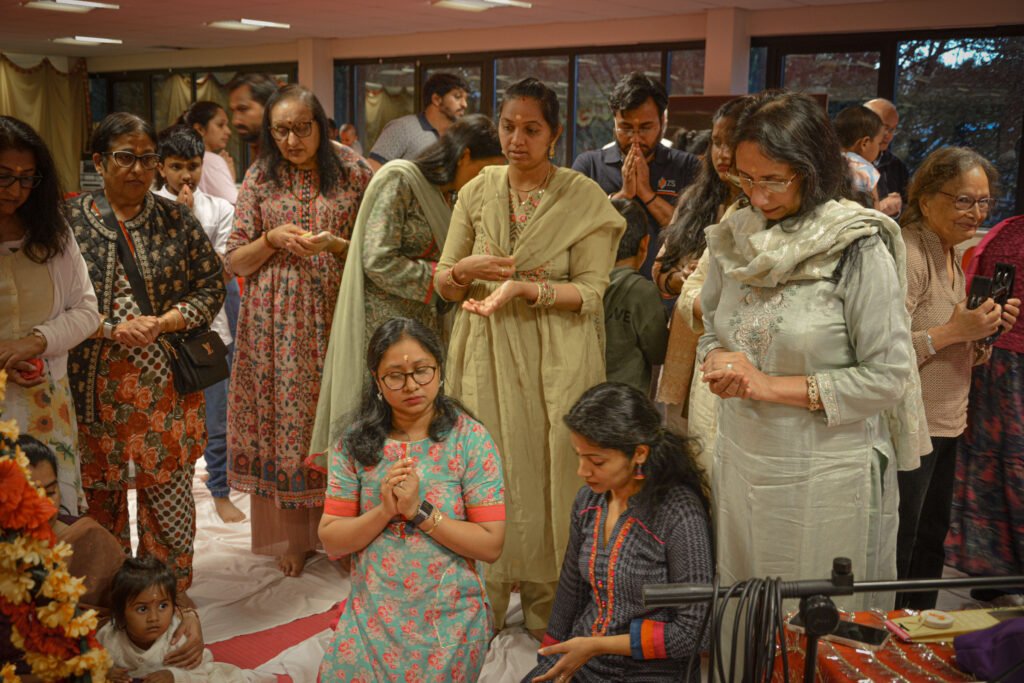
The rituals themselves reflected the same participatory spirit I had noticed the previous evening. Children were given opportunities to take part in the pooja, while adults were encouraged to perform elements of the worship with their own hands rather than simply watch.
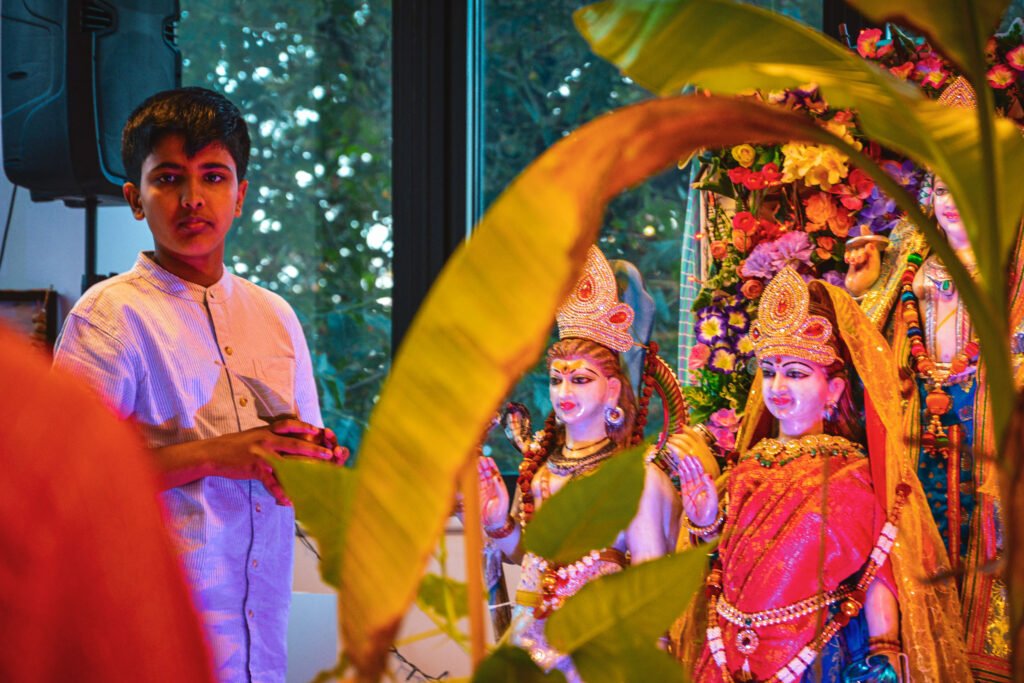
At one point, women gathered around one side of the ceremony performing Ganesh pooja, while elsewhere garlands were being offered to the murti. There was movement everywhere, but it never felt chaotic. The celebration belonged to the people in the room.
The Energy Behind the Microphone
Among the people helping carry the evening forward was Sri Goberdhan.
Sri works in scientific research, which made her energy that evening all the more striking to me. Even after a full working day, she seemed to have an almost endless reserve of energy for the people around her.
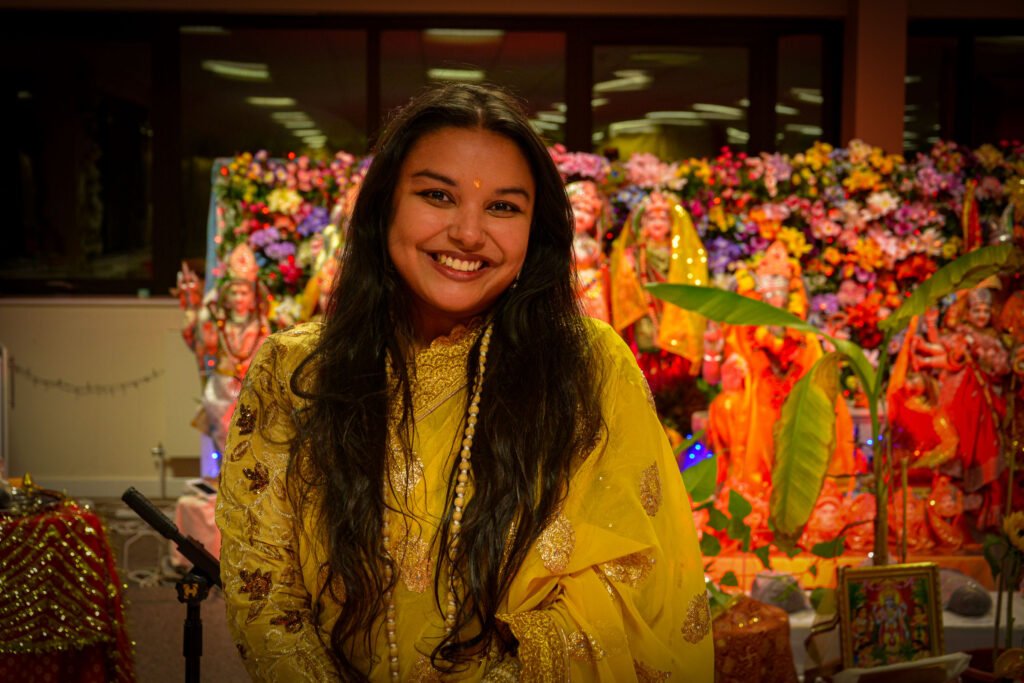
Throughout the evening, she was constantly listening for cues from Guruji, guiding the gathering through the microphone and helping the different parts of the ceremony flow into one another.
But what I remember most is the joy with which she did it.
She smiled as she spoke, encouraged the children in front of her and, moments later, would be singing along with everyone else.
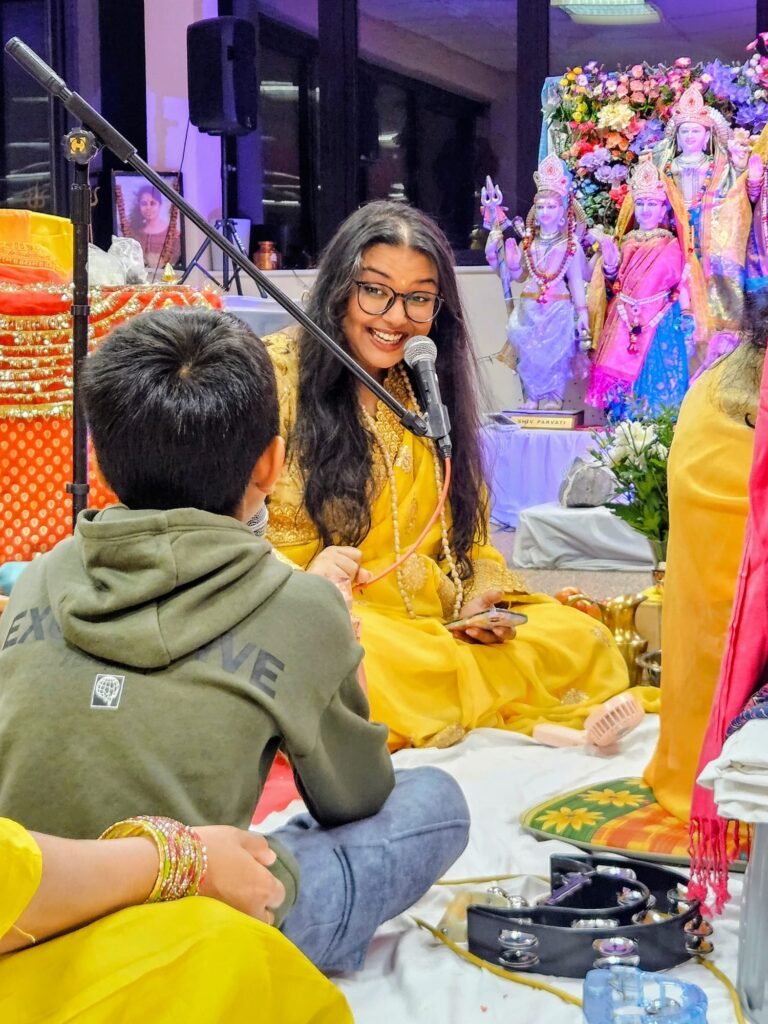
When the familiar call of “Morya Re, Bappa Morya Re” filled the hall, people began joining hands as they sang.
For a moment, the distinction between organiser and attendee seemed to disappear completely.
Everyone was simply part of the celebration.
From Behind the Camera to Part of the Room
Newport also gave me something I had not expected.
During previous celebrations, I had often been the person moving quietly around with a camera. People had seen me taking photographs, but with a busy temple and a crowded programme there was rarely much opportunity to actually speak.
This evening was different.
People came over to talk. Some recognised me not only as the person behind the camera but as the person behind the Janmashtami story I had published a few weeks earlier.
I genuinely had not expected that.
Even more surprising was discovering that people remembered the article well enough to connect it with my face. Hearing them praise it felt like a small achievement; hearing Guruji praise it too when I went to take his aashirwad felt like a blessing.
Perhaps because the gathering was smaller, there was also more space for me to stop documenting and simply participate.
I helped around the food and kitchen, and later with cleaning as the evening came to an end. Strangely, that did not feel like helping at somebody else’s event.
It felt like helping at our event.
That difference stayed with me.
There were lighter moments too. Dr Yogesh managed to slip a Ganesh Chaturthi joke into the evening, a reminder that devotion here was never separated from laughter and the ordinary warmth of people enjoying one another’s company.
And when my wife and I went over to greet Sri, her reaction was immediate: a broad smile and a warm hug.
It was a small gesture, but one that captured much of what the evening had come to represent for me.
Together in Aarti
As in Cardiff, the evening moved towards Samuhik Aarti.
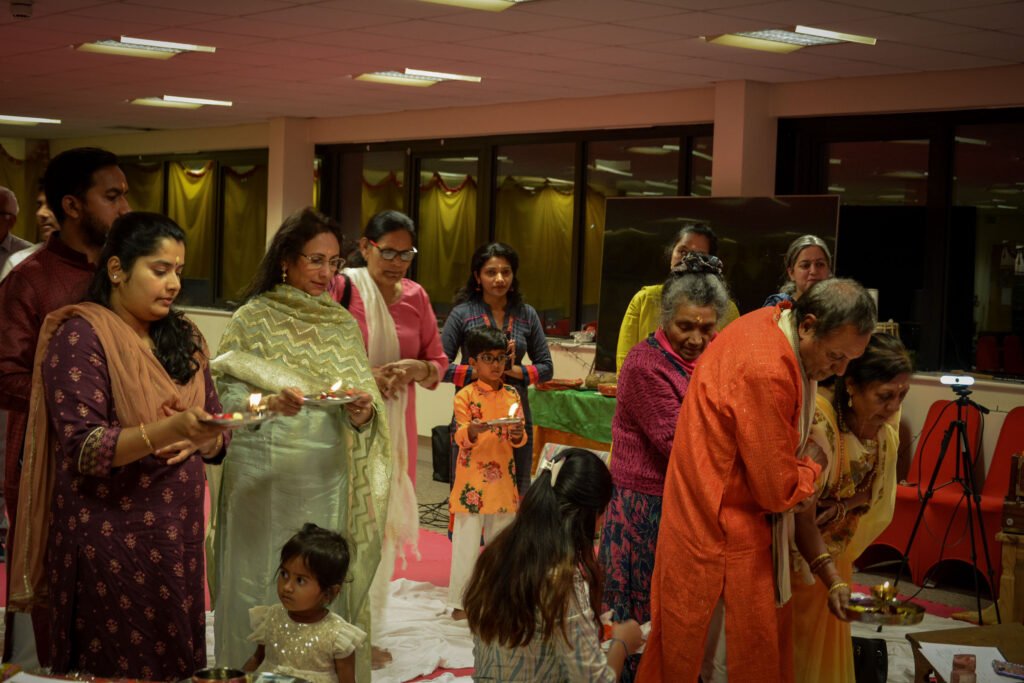
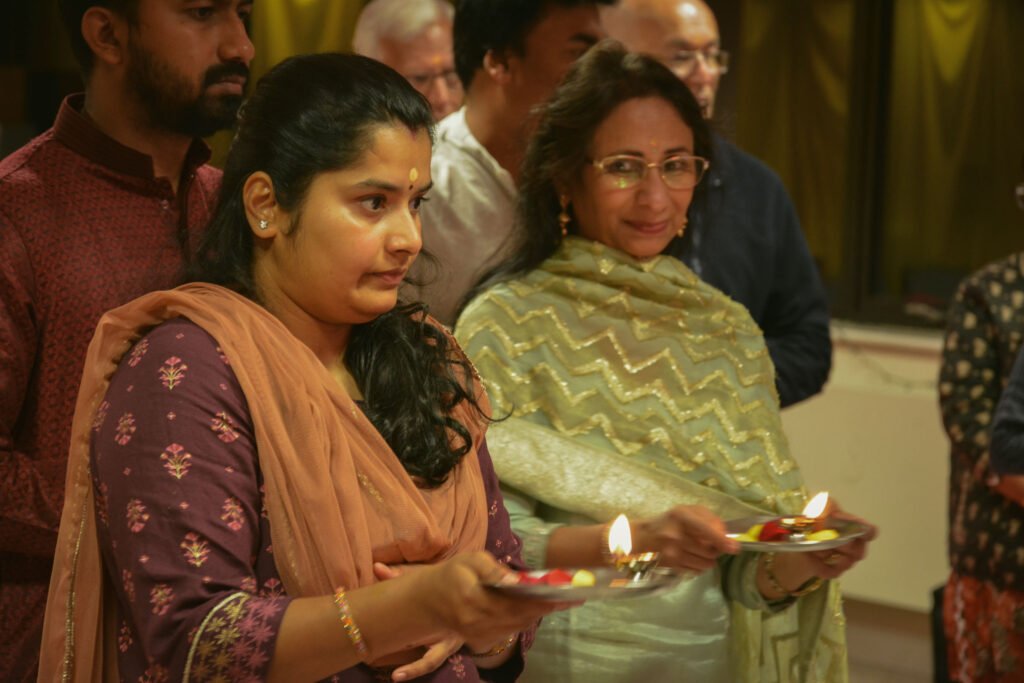
Prasadam followed.
I have always felt particularly grateful for this part of these gatherings. Food after a ceremony can appear like a simple closing tradition, but on evenings like these it feels like something more.
People had arrived after work. Children had school again the following morning. Many still had a journey home ahead of them.
And yet the community did not simply bring everybody together to pray — it made sure they left cared for and fed as well.
What We Carry Home
Across the two evenings, the celebrations were different in scale, but what stayed with me was how much they shared.
In Cardiff, I watched children being encouraged to step forward, elders filling the hall with familiar bhajans, and people such as Sowmya Ji putting their time and energy into making tradition something the next generation could participate in rather than simply observe.
A day later in Newport, I saw the same idea take another form — children performing the pooja, families worshipping together, Guruji guiding the gathering and Sri somehow keeping the room moving with an energy that seemed untouched by the working day that had come before it.
People like Sri and Sowmya Ji remind me that traditions do not simply survive because they are old. They survive because people continue to teach them, organise around them, sing them, explain them and — perhaps most importantly — make space for children to make those traditions their own.
For me, these two evenings also felt a little different from the celebrations I had photographed before.
I still spent plenty of time behind the camera, but increasingly I found myself on the other side of it too — talking, helping, taking part and being recognised by people whose stories I had previously only tried to document.
Perhaps that is why leaving felt harder than expected.
Both celebrations had taken place on weekday evenings. By the end, we were tired. Work was waiting again in the morning, and school was waiting for the children.
Still, none of us particularly wanted the evening to end.
And somewhere on the journey home, without anyone suggesting it, we realised we had started singing the bhajan again.
For a little while longer, Ganapati was coming home with us.
— Ishan Singh
Hearth & Lens Magazine